There are two ways to look at this, but the most obvious answer is actually the opposite of what most people would think.
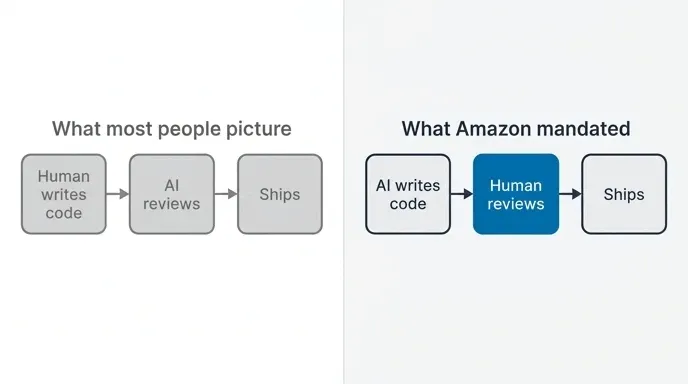
When most people hear “AI code review”, they imagine a robot checking pull requests and finding mistakes that humans might miss. Amazon did the opposite. They told engineers that any code created by AI needed human approval before it could go to production. In this case, the AI is not reviewing the code; instead, the code written by AI is what gets reviewed.
Amazon spent five months reaching this decision. Along the way, there were two outages and even a public denial that didn’t hold up.
It started with a push in the opposite direction
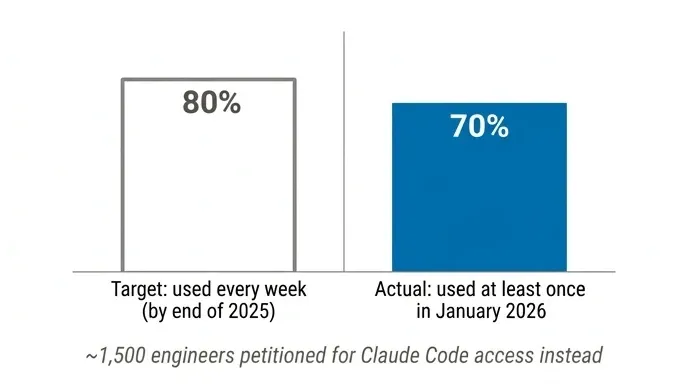
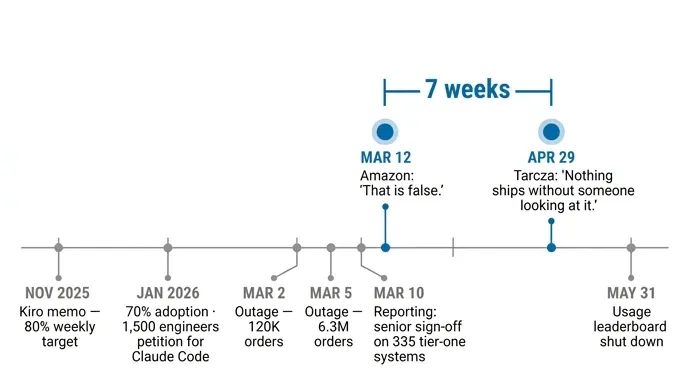
In November 2025, two senior vice presidents, Peter DeSantis from AWS and Dave Treadwell from the eCommerce Foundation, sent an internal memo making Kiro, Amazon’s own coding tool, the standard. The message was clear: “Although we will continue to support the existing tools currently in use, we have no intention of supporting any additional third-party AI development tools”. This meant that tools like Claude Code, Codex, and Cursor were no longer allowed. Leadership wanted 80% of engineers using Kiro each week by the end of the year.
Adoption was not as high as expected. By January 2026, about 70% of Amazon’s engineers had tried Kiro at least once. However, interest was even lower. Around 1,500 engineers signed an internal post asking for official access to Claude Code, saying it was better for tasks like multi-language refactoring. This was awkward because Amazon sells Claude through Bedrock.
This isn’t the real code review policy; it’s just some background information.
Then March happened
On March 2 there was a retail incident which, according to internal documents, caused 120,000 orders to be lost and 1.6 million website errors.
A bigger incident happened three days later. Checkout, login, and pricing functions failed for several hours, and Downdetector recorded over 20,000 complaints. Business Insider, using internal documents, reported that the second outage caused 6.3 million lost orders. This nearly stopped all ordering on the North American marketplace during the outage.
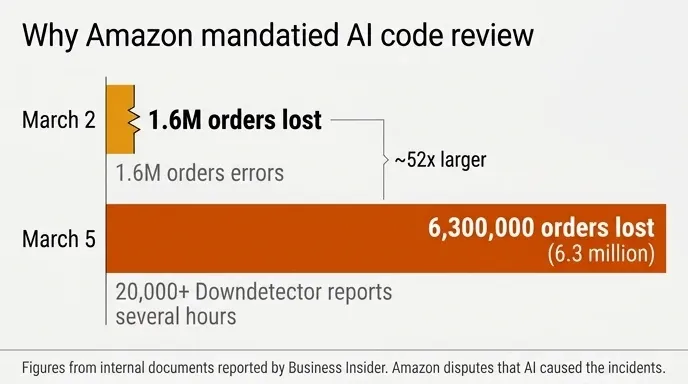
The way the briefing documents described the events made the news even more important. Notes for Amazon’s weekly stores-tech meeting mentioned a “trend of incidents” with a “high blast radius” and connected them to “Gen-AI assisted changes” going back to the third quarter of 2025. The Financial Times summed it up: the AI wrote the code, and that code broke Amazon.
News of Amazon’s response spread quickly. From that point on, any AI-assisted changes to about 335 tier-one systems, which handle orders, payments, and pricing, needed approval from a senior engineer. Production changes had to be reviewed by two people. This setup was meant to last for 90 days, a period one Amazon employee called “controlled friction.”
Amazon said that wasn’t what happened
On March 12 the company issued a correction in its own newsroom and didn’t qualify it.
Amazon stated that of the recent incidents only one involved the AI tools in any way, and in that case it wasn’t actually about AI since the cause had been “an engineer acting on inaccurate advice which an AI tool had inferred from an out-of-date internal wiki.” Action had been taken based on faulty guidance. The problem was not with the code itself.
There then came a straight-out denial: “Amazon has introduced new approval requirements for engineers who are working with AI tools. That is false.”
Not everyone agreed with that statement. Corey Quinn, who has studied AWS’s public comments for years, said, “AWS prefers for the world to think that their engineers are incompetent rather than acknowledge that their artificial intelligence has made a mistake.”
Seven weeks later, a director described the policy anyway
At the AWS London Summit on April 29th, Steve Tarcza, who is a director at Amazon Stores and heads an internal developer-tooling group, answered questions regarding the safety of using agentic AI on a large scale.
He said that engineers must always review the output, and nothing is shipped unless someone checks and approves it.
For AI agents in particular, every step that changes something must be approved by a human.
You might try to compare this with what was said in March. The denial was specific, saying the requirements were not new, rather than saying they never existed. It is possible that Amazon always required reviews but only started enforcing them more strictly. Tarcza was not talking about the outages; he was explaining how his teams work. He also said that spec-driven development helps reduce hallucinations and prompt injection, though it does not remove them completely. On hiring, he said: “we can’t reach the stage where we don’t have a continual influx of junior engineers.”
Still, the gap between saying ‘that is false’ in March and ‘nothing ships without someone looking at it’ in April is the most interesting part of this story. Most coverage missed this because reporting had mostly stopped by March.
The leaderboard nobody could stop gaming
That’s the final piece, and it could end up being the most useful one.
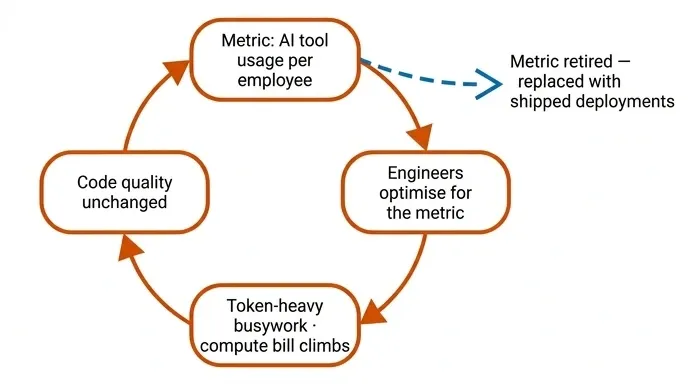
Amazon had an internal leaderboard that ranked employees by how much they used AI tools. The system was shut down at the end of May. Officially, the company said it had served its purpose, but employees told reporters otherwise. The leaderboard was easy to cheat, and people gamed the system by doing pointless tasks that used lots of tokens to boost their rankings. This also increased Amazon’s computing costs. One person even admitted to gaming the system after being told they were not using enough AI.
The metric used for the replacement is the number of deployments.
This is a clear example of Goodhart’s Law: when you measure usage, you get more usage, not better code, not faster delivery, just more tokens.
The part that generalizes
Amazon is actually different from the others, even if that is surprising.
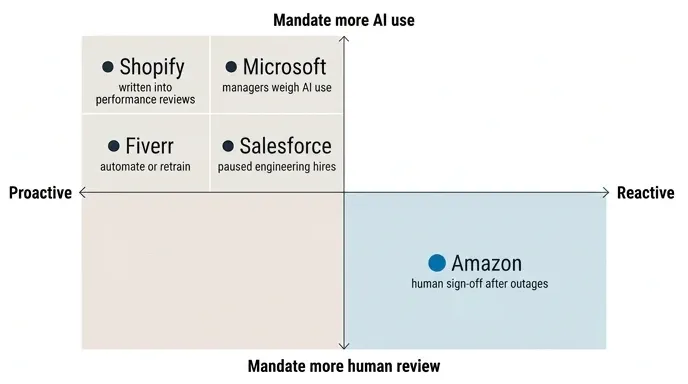
Shopify set a baseline expectation and included it in performance reviews, and Microsoft told its managers to do the same. Fiverr’s CEO told employees to automate repetitive tasks or consider a new career. Salesforce paused engineering hiring, saying agents were doing a third of the internal work. All these policies aim to use resources better, move faster, and show that it is possible.
While other companies take the opposite approach, Amazon’s AI code review policy asks for more human oversight, not less. It was introduced because of production problems.
Research shows this is a common pattern. DORA’s study on AI-assisted development found that AI acts as an amplifier, making everything an organization does more noticeable, including its weaknesses. A 2026 developer survey by Sonar found that AI wrote 42% of committed code, but 96% of developers said they do not fully trust it. Teams spent about a quarter of each week checking and fixing AI-generated code. Thirty-eight percent said reviewing AI-written code takes more effort than reviewing a colleague’s work.
The truth is that AI’s output is not bad. What has changed is that generating code is now easier, but checking it is not. Any time saved early on is later balanced out by extra review work, whether people expected it or not.
Amazon’s decision to require AI code reviews is not a step back from using AI. Instead, it happened because the company could no longer review code at scale in public after previously pushing everyone to move faster.