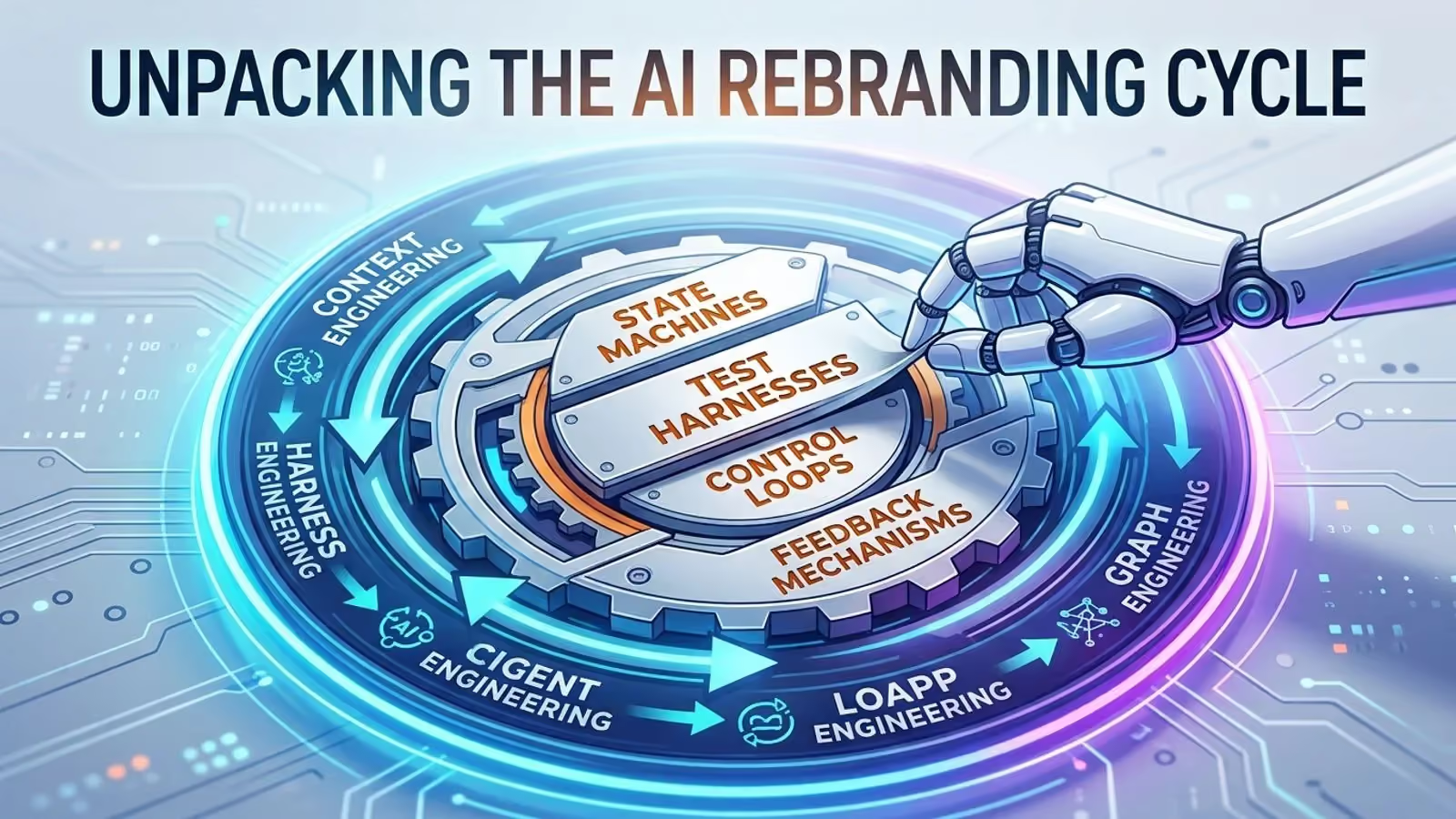
Earlier this year, someone asked on r/AI_Agents, “There’s a lot of talk about Harness Engineering; what does that even mean?” It was a fair question. Ironically, by the time the thread got noticed, the people who first made the term popular were already moving on from it.
The real story is in how quickly these terms come and go. It’s less about the words themselves and more about how fast they get a Wikipedia page and then get replaced.
One of these actually earned its name
Prompt engineering showed up as soon as chatbots did, and it meant just what it sounded like: the way you phrase things when you type into a box changes the output.
Then developers started using APIs instead of typing into boxes. Shopify’s CEO, Tobi Lütke, named this shift ‘context engineering’ in a tweet on June 19, 2025. Karpathy mentioned it a few days later, and in September, Anthropic published an article that explained the practice, covering instructions, retrieved documents, tool definitions, memory, and state.
From the model’s perspective, nothing has really changed. It’s still just tokens in a context window and still just a prompt. The model can’t tell the difference between a well-worded question and forty thousand tokens of assembled state.
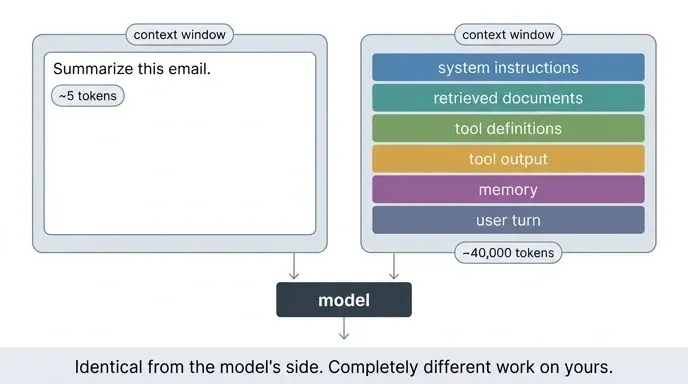
So why does the name stick? It’s because the term isn’t about a change in the model, but a change in the job. Putting together that context, choosing what to retrieve, what to summarize, and how tools return information is a different kind of work than just writing a good question. That’s why it earned its own name.
That’s where things start to break down.
Then the naming got out of hand
About eighteen months later, four more terms showed up.
- Harness engineering. In November 2025, Anthropic used the word ‘harness’ to describe this idea. Mitchell Hashimoto, known for Terraform, Vagrant, and Ghostty, summed it up as ‘Agent = Model + Harness’ in February 2026. Soon after, there were posts from OpenAI and Martin Fowler, a Wikipedia entry, several arXiv papers, an awesome-list, and a bunch of ‘Definitive 2026 Guide’ pages from companies selling related products.
- Loop engineering. Boris Cherny and Peter Steinberger had already shared ideas in this area, and Addy Osmani mentioned them on June 7, 2026. Nine days later, LangChain created a four-level model for it. Within two months, IBM made a dedicated topic page. Swyx calls the same field ‘loopcraft.’
- Graph engineering. A blog post appeared on July 18, 2026. TrueFoundry picked up the idea two days later, and four days after that, LangChain published their own post called “3 Years of Graph Engineering with LangGraph.”
- Orbs. Amp started using this term around June 2026. It means a lightweight cloud machine assigned to each agent thread, so your laptop can rest while the work happens somewhere else.
The tell is in the dates
There’s a tidy sequence being shared: Prompt → Context → Loop → Harness. Each step covers more than the last. Companies like this setup because it makes their product part of the ladder.
If you try to put these terms in chronological order, it doesn’t add up. Harness was named in February, and Loop in June. The ladder came later, and the order was chosen to look inevitable, but that’s not the same as real history.
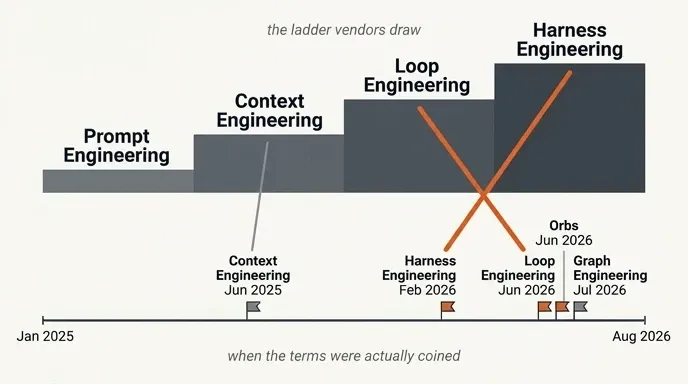
It’s worth looking at the LangChain title again. It was published just four days after the term was first used, even though the work had been going on for three years. The company made it clear: the practice was real, but the label was new. That’s what happened in all four cases.
In other places, LangChain drops the ladder idea and treats loop, harness, and graph as siblings, with no order or layers. The same company presents the material in two different ways, and they don’t match up. Neither is completely wrong. Both are marketing diagrams added on top of work that was already happening.
Strip the labels and look at what’s underneath
The harness component described by Fowler divides the parts into “guides” and “sensors” - that is, feedforward controls and feedback controls - which is the principle of control theory and one that has been taught for decades.
If you keep digging, the whole set of terms falls apart:
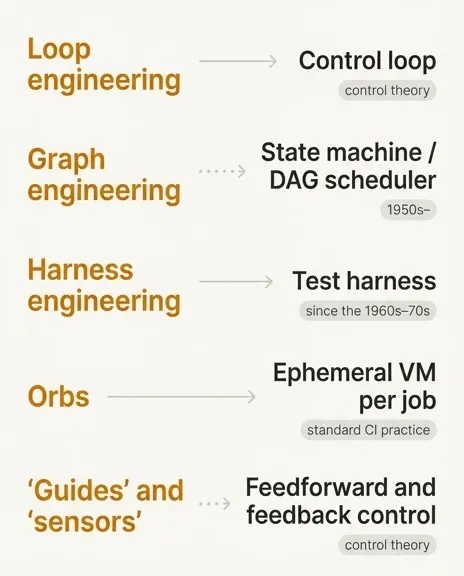
- A control loop is a cycle which acts, observes the result, makes corrections, and then repeats this process until the task is completed.
- A state machine consists of nodes, edges, allowed transitions, and a common state object. If you connect the nodes in an acyclic manner, you have a DAG scheduler.
- The term “harness” is directly taken from “test harness”, a term which has always meant approximately this, the setup or apparatus surrounding the item being tested.
- The orb consists of a new virtual machine for each job, which is then destroyed afterwards; this approach has been used for years by every continuous integration system in the world. Amp’s method charges by the minute and uses Debian.
This isn’t a criticism of the work itself; it’s actually good work. The point is that developers building real agent systems did all these things from the start, like retries, isolation, supervision, structured handoffs, and keeping state between runs, without waiting for permission or a special term. They did it because that’s what it takes to build a system that keeps running. It didn’t feel like a new field; it just felt like a regular Tuesday.
The names are churning faster than anyone can learn them
Thorsten Ball, who is involved with Amp and has been the most outspoken advocate of orbs, stated in August: “The thing that we referred to as harness over the last year is becoming ever less important. What we now need to concentrate on is higher-level abstractions such as orbs and portals.”
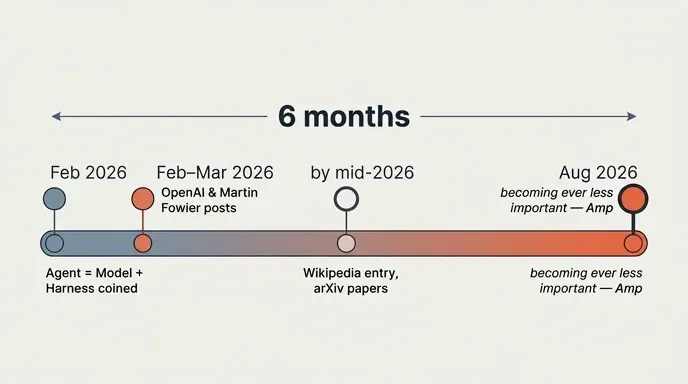
Look at the timing. ‘Harness engineering’ was first mentioned in February, had academic papers and an encyclopedia entry by summer, and was called commoditized by year’s end. Anyone trying to learn ‘harness engineering’ during that time was really just learning the name, not the actual work. The real practices, sandboxing, tool design, and error recovery, were around before the term and stayed after it faded.
The naming trend hasn’t stopped. Now there’s a job called Evals engineering, with salaries from $230k to $650k. Agent engineering has its own annual report and a conference in London. Both are real jobs, but they used to be called ‘testing’ and ‘building systems’ before someone saw a branding opportunity.
Think about the things that never got a special name. Memory, tool design, and orchestration were always discussed and were central to every system, but no one bothered to label them. It seems a name only appears when there’s something to sell with it.
What to actually take from this
It’s important to learn the mechanics: feedback loops, isolation boundaries, explicit state, and knowing when to hand off between components or keep them together. This kind of knowledge lasts and comes straight from distributed systems and control engineering, where it’s always been found.
Treat the vocabulary like the weather. Use a term if it helps explain your design to your team. If you see a ‘definitive guide’ from a company selling the product it recommends, pay attention to who’s behind the definition.
The engineering is real and challenging. The renaming is just content.