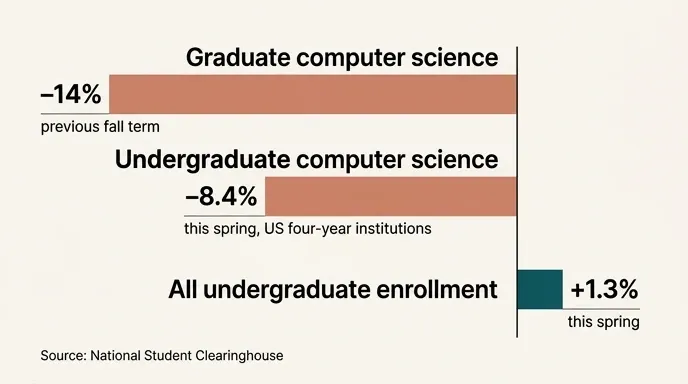
This spring, undergraduate computer science enrollment at four-year US colleges dropped by 8.4% according to the National Student Clearinghouse, even though overall undergraduate numbers went up by 1.3%. Every type of school saw this decline, and graduate CS programs were down 14% the previous fall. Students seem to be noticing that machines are now doing much of the coding.
So the question I keep getting from the children who are entering their higher studies is a genuine one: is studying computer science still worth four years of their life? My answer has two parts, and the first one isn’t very encouraging.
If you came for the salary, don’t come
Over the past decade, many people chose computer science mainly for the good pay, not because they loved the subject. That’s a reasonable choice. But a lot of them only learned how to type a question into a search box, find some code that works, and stop once it runs.
That approach worked when there weren’t enough people to do the typing. Now, typing isn’t rare. If your main skill is putting together code you don’t really understand from the internet, an AI can already do that faster and cheaper. I don’t think that kind of job will return. If that was your plan, my honest advice is to look for something you truly want to do.
The rest of this article is for those who really enjoy computer science and are wondering if their interest is enough to make the commitment worthwhile. For you, I believe this is actually a good time to enter the field. Just not for the reason the field used to sell.
Strongest version of the argument
Let me be honest about the strongest argument against my view, because much of it is true. AI can write good code, not just simple examples, but code that covers different cases, has tests, and adapts when requirements change. For well-understood tasks, it does this better than I can, and better than most people reading this will ever be.
Fine. Then why keep a human anywhere near it?
The reason is that software is made for people and sold to people, and someone has to take responsibility for it. Not just legally, but in everyday terms. Someone needs to say, “This is what we built. This is why. Here’s what happens if it’s wrong. I made the decision.”
That’s not just about writing code. I’ve said before that coding was never the hard part of shipping, and this is where that idea leads: the developer job, turning a plan into working code, is the part AI can now handle easily. What remains is the role of the engineer: someone who builds what people really need, decides which risks are okay, and stands behind the result.
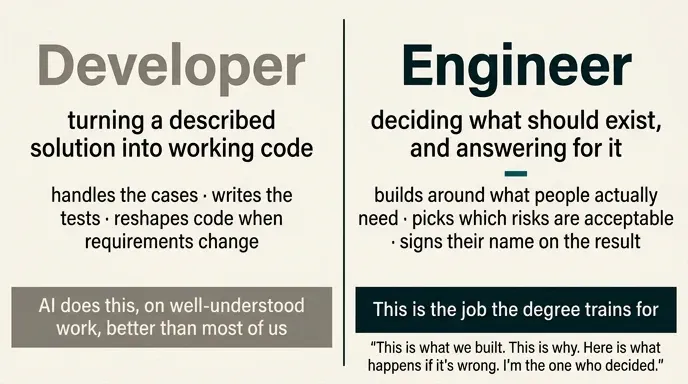
If you’re choosing a degree in CS now, that’s the job you’re training for. It’s always been the more interesting part of the work anyway.
The part that hasn’t gotten cheaper
Here’s what I’ve noticed in my own teams, though I want to be careful since this is just my observation, not a formal study.
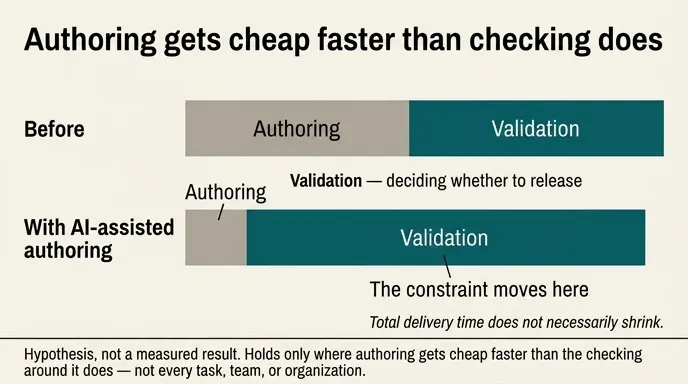
The real challenge isn’t building something that works. It’s figuring out if what you built is correct, appropriate, secure, maintainable, and actually worth releasing. I’ve seen working code exist before anyone decided what rules the system must follow, what proof is needed, or what decisions that proof should support. A passing test tells you less than people assume. It just means a check ran, not that the code is ready to release.
That constraint was there before AI. It’s independent of AI.
When AI speeds up coding more than it speeds up checking and validation, deciding whether to release (verification judgment) becomes the main bottleneck. This won’t be true everywhere or for every team, but in those cases, the rare skill isn’t building something. It’s knowing if it’s ready to ship.
Think about what this skill involves: knowing which behaviors must be guaranteed, which security and functional rules must hold, and what needs to be checked before release. It’s about picking evidence that truly proves something is ready, not just that it passed a test. It also means keeping the architecture solid, since faster code generation doesn’t solve issues like system boundaries or trade-offs. And it means handling privacy, governance, and regulations that decide what can be shipped responsibly.
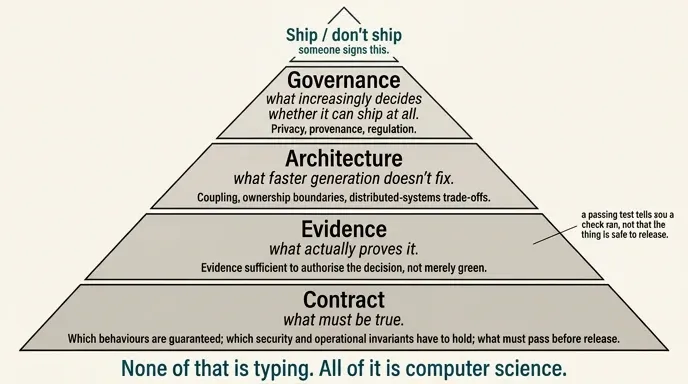
None of this is just about typing code. All of it is real computer science.
Where I might be wrong
The examples I’ve shared support what I’ve noticed, but they don’t prove my point. To really test this, we’d need before-and-after data on coding, validation, and delivery. I don’t have that, and neither does anyone I’ve read. The evidence on whether AI makes developers faster at all is genuinely mixed.
Things could turn out differently. AI might get better at technical judgment just as quickly as it got better at writing code. Automated tests, formal checks, and AI reviews might prevent verification from becoming a big bottleneck. Some companies might see big productivity gains without extra risk. And maybe “engineering judgment” is too broad a term to be helpful. That’s a fair point, and I recognize it in my own argument.
But I don’t think accountability will change. Someone still needs to decide what should be built and take responsibility for it afterward.
So what do you actually learn
Andrew Ng in March 2025: telling people not to learn programming because AI will automate it “will be seen as some of the worst career advice ever given”. He points out that every time coding got easier, from assembly to high-level languages, from editors to IDEs to AI assistants, more people started coding, not fewer. As he says, “As coding becomes easier, more people should code, not fewer!”
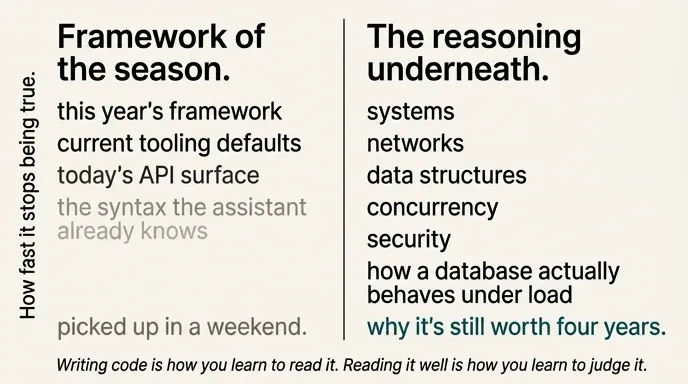
I agree with his conclusion, though I’d put it a bit differently. “Learn to code because writing code teaches you how to read it, and reading it well helps you judge it. The act of typing is the practice, not the end goal.” If you’ve never built a distributed system, you can’t really judge if an AI-generated one is solid, and you shouldn’t be the one to approve it.
This means the basics you might have wanted to skip are actually the most valuable. Things like systems, networks, data structures, concurrency, security, and how databases really work under pressure. The core reasoning matters more than the latest framework. You can’t learn these things in a weekend tutorial, which is why they’re still worth four years of study. I’ve written more about the skills this shifts toward for people early in their careers.
A computer science degree was never a ticket, even if it felt like one for about fifteen years. That’s what’s changing now. The degree is really training for the part of the job that still needs a human to make decisions. If you enjoy the subject, this is the best deal you could hope for. If you don’t, no amount of AI will make this a comfortable career.