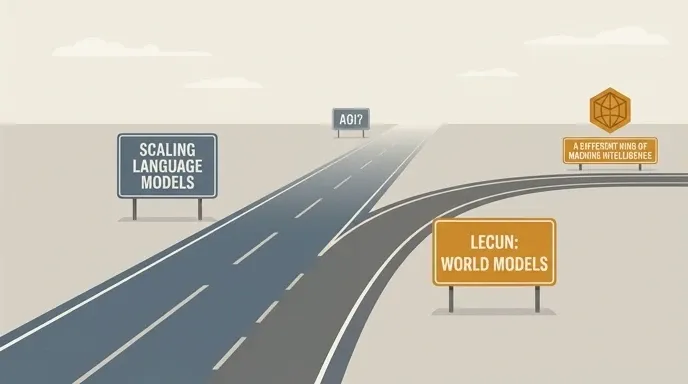
In March, fourteen Microsoft researchers published a paper stating that GPT-4 “could reasonably be viewed as an early (yet still incomplete) version of an artificial general intelligence (AGI) system”. They titled it Sparks of Artificial General Intelligence. Just a month before, Yann LeCun, a key figure in modern deep learning, wrote that large language models are actually an off-ramp on the road to human-level AI.
Both groups are using the same technology. They are among the most respected in the field, yet they have completely different views.
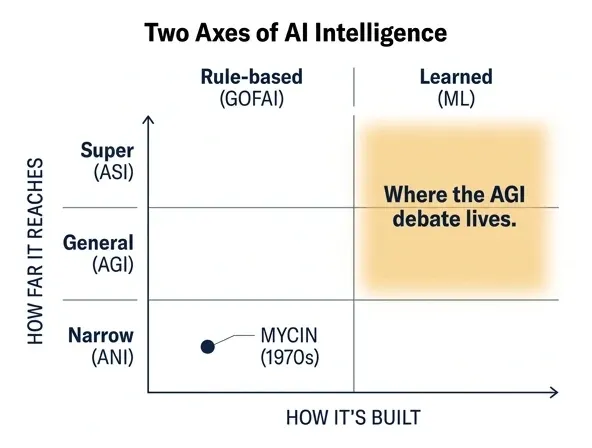
Neither side is being careless. The real issue is that the question “how smart is this AI” actually combines two separate questions. Which one you focus on determines whether you see today’s AI as the result of seventy years of progress or as a complicated dead end.
The first question is about how the system is built: were the rules written by a person, or did the machine learn them from data? The second question is about how far it reaches: does it handle just one narrow task, or can it tackle anything? These are separate issues. Once you separate them, the debates become much clearer.
When humans wrote every rule
Begin at a summer workshop at Dartmouth in 1956. John McCarthy needed a label for what he, Marvin Minsky, Nathaniel Rochester, and Claude Shannon were proposing to study, and he settled on “artificial intelligence”. The field got its name before it had a single working system.
For roughly thirty years after, the main belief was that thinking meant manipulating symbols. People would break a problem into parts and write clear rules for every situation the machine might face. If X, then Y. The philosopher John Haugeland later named this era GOFAI, short for Good Old-Fashioned AI, though no one at the time used that label. You might also see it called symbolic AI, expert systems, or rule-based systems.
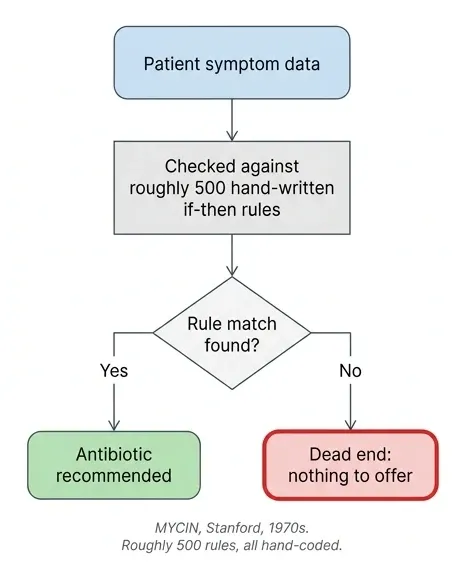
MYCIN is the one to remember. Built at Stanford in the 1970s under Edward Feigenbaum, it diagnosed blood infections and recommended antibiotics off roughly 500 handwritten rules. Not five hundred as a figure of speech, five hundred actual rules, typed in by humans. It performed close to a specialist. Its predecessor DENDRAL, from the late sixties, worked out molecular structures the same way.
Think about that for a moment, because it shows the limits of this whole approach. MYCIN could only handle situations that someone had already thought of. Its intelligence ended where its creators’ imagination did. If a new scenario came up, the machine had nothing to offer.
This limitation gave John Searle his opportunity in 1980 to draw a line between weak AI, which is a program that only simulates thinking as a tool, and strong AI, which would truly understand. Even today, people often use “strong AI” as another term for AGI.
A quick word about fuzzy logic
Plenty of write-ups get this bit wrong, so it’s worth slowing down.
In 1965, Lotfi Zadeh published “Fuzzy Sets” and introduced a powerful new idea: instead of rules being only true or false, they could have degrees in between. With this, terms like “somewhat cold” and “very cold” could be understood by a machine using math, instead of being pushed into just one box. This method worked well in real life. For example, the subway system in Sendai, Japan, started using fuzzy control in 1987 and became a classic example.
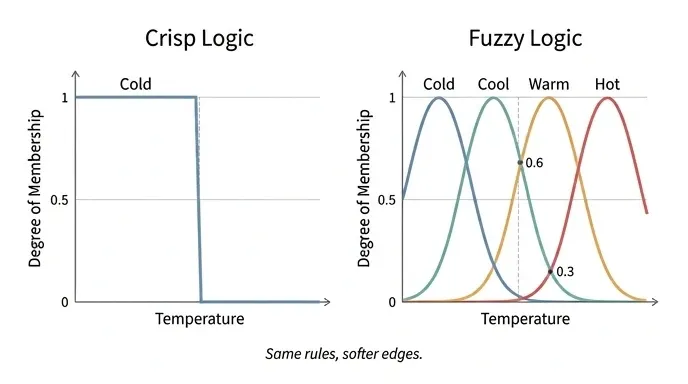
However, fuzzy logic is not a step between rule-based systems and machine learning. Instead, it is a way for rule-based systems to improve at what they already do. Humans still write the rules, but now those rules can be uncertain. Zadeh’s paper appeared the same year symbolic AI was already developing, and fuzzy methods grew alongside expert systems during the 1980s and 1990s, long before statistics became central. It’s more of a sideways improvement than a step up.
Learning instead of being told
The real turning point happened when systems stopped relying on rules given by humans and began learning from examples instead.
This shift changed everything and set a new limit. A learning system is no longer limited by what its creator imagined. Instead, it is limited by the data it receives and how well it can find patterns in that data. For example, nobody ever wrote a rule describing what a cat looks like.
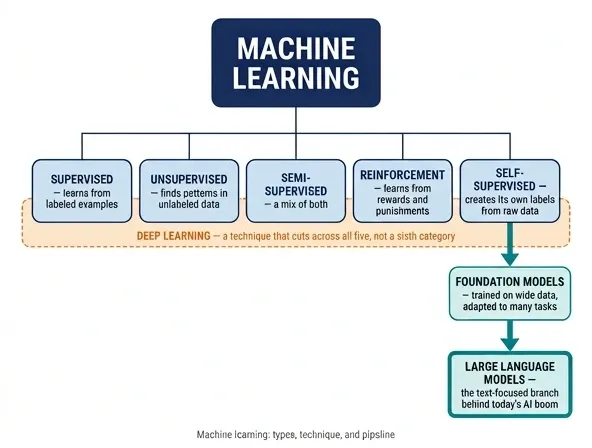
This field now has its own set of terms. Supervised learning uses labeled examples to train. Unsupervised learning looks for patterns in data that has not been labeled. Semi-supervised learning is a mix of both. Reinforcement learning does not use datasets at all; it learns by receiving rewards or punishments as it interacts with its environment. Deep learning is the part of the field that uses artificial neural networks.
Next came self-supervised learning, where a model creates its own labels directly from raw data. This is the key that made today’s language models possible. When you scale this up, you get foundation models: huge systems trained on a wide range of data, which can then be adapted to many different tasks. Large language models are the part of this world focused on text, and they are the reason people are talking about AI so much today.
Narrow, general, super
Now let’s look at the second axis: not how these systems are built, but how far they can go.
The three-tier version is probably familiar. ANI, artificial narrow intelligence, covers systems that do one job or one family of jobs, which under most definitions is everything that exists. AGI, artificial general intelligence, would match human versatility across most domains. ASI, artificial superintelligence, would beat the best humans at essentially everything.
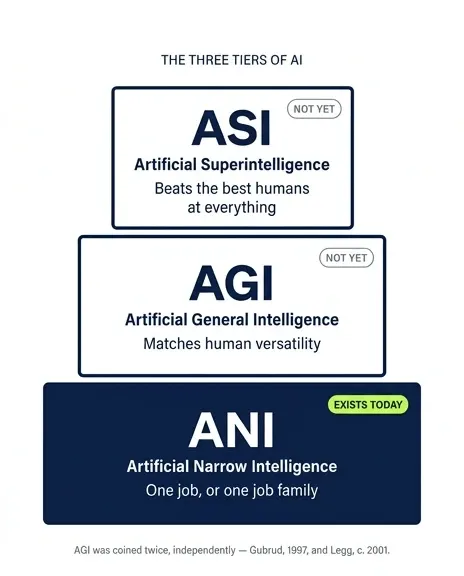
The term in the middle, AGI, appeared twice. Mark Gubrud first used “advanced artificial general intelligence” in a 1997 nanotechnology paper, but it did not become widely used. Years later, Shane Legg came up with the term AGI on his own while writing a machine learning book with Ben Goertzel, not realizing Gubrud had used it before. They wanted a name to separate general-purpose intelligence from the narrow types of algorithms that were common then. Legg’s version is the one people use today.
Nobody has built the scale yet
Here’s something unusual, and it helps explain why these debates often go in circles.
Car companies figured this out years ago. The SAE J3016 standard rates driving automation from 0 to 5: no automation, driver assistance, partial, conditional, high, and full automation. When someone says a car is Level 3, everyone knows what that means. AI does not have a similar system. Instead, there are just three broad categories, with a huge gap between the second and third.
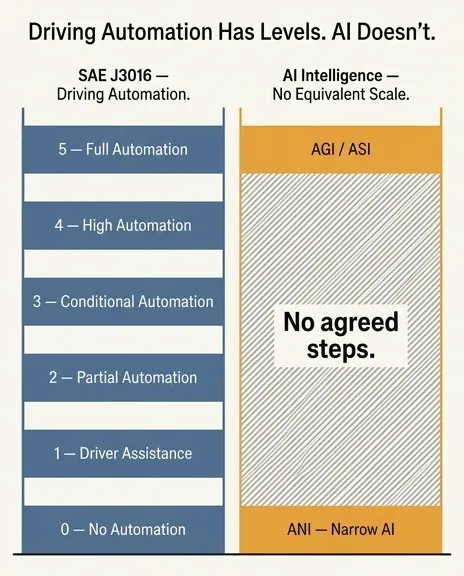
Instead, there are several different proposed finish lines. Turing suggested the first one in 1950 with his imitation game. In 2005, Nils Nilsson proposed an employment test: an AI would qualify if it could fully automate important jobs. Around 2012, Goertzel added two more: the coffee test, where a machine enters a typical American home and figures out how to make coffee by finding the machine, learning the buttons, and locating the coffee grounds (an idea inspired by Steve Wozniak), and the robot college student test, where a machine enrolls at a university, attends classes, and graduates like any other student.
These are all thresholds, not levels. You either pass or fail, with nothing in between. This is not a good way to measure something that is clearly improving step by step. It’s also worth noting that when OpenAI included AGI in its 2018 charter as “highly autonomous systems that outperform humans at most economically valuable work,” it was basically adopting Nilsson’s employment test as its goal.
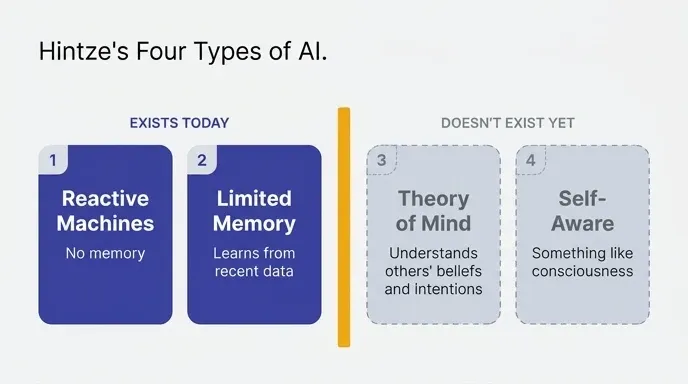
The only widely used graded system comes from Arend Hintze, who described four types in The Conversation in 2016: reactive machines with no memory, limited memory systems that learn from recent data, theory of mind machines that understand what others believe and feel, and self-aware systems with something like consciousness. The first two types exist, but the last two do not. The gap between the second and third types is especially important. This system is a helpful teaching tool, but it should not be confused with a way to measure progress.
For a more precise approach, François Chollet’s 2019 paper “On the Measure of Intelligence” argues that we have been testing the wrong things. Being good at a task does not tell you much; what really matters is how quickly a system can learn new skills. His ARC benchmark uses puzzles that humans find easy but cannot be solved by memorization. It is designed so that no lab can achieve a high score just by adding more training data.
What happens after human-level
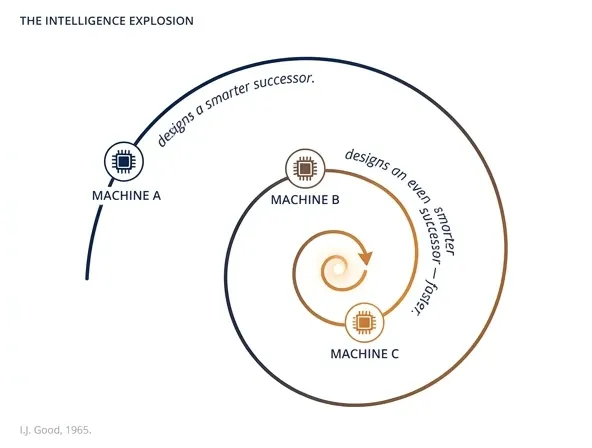
The idea that superintelligence could appear suddenly, not gradually, is almost sixty years old. I.J. Good described it in 1965: an ultraintelligent machine would surpass humans at every intellectual task, including designing even better machines. Each new machine could then improve on itself. Good called this an intelligence explosion, and every argument about recursive self-improvement since then is based on this idea.
Nick Bostrom added more detail to this idea in 2014. He described superintelligence as coming in three forms: speed, where a system thinks like a person but much faster; collective, where many human-level agents work together to achieve more than any individual could; and quality, where the intelligence is not just greater in amount, but different in kind.
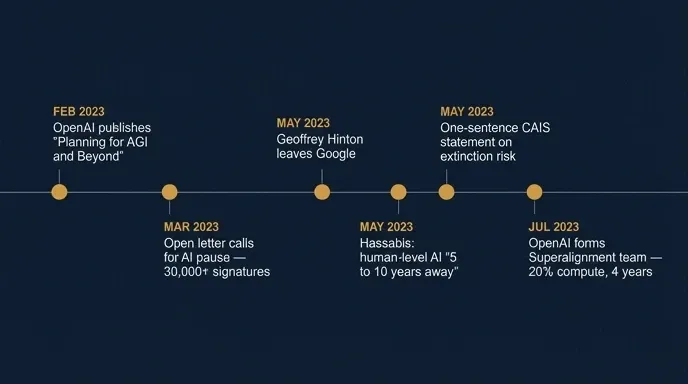
For a long time, this was just an academic topic. That is no longer the case. In July, OpenAI created a Superalignment team led by Ilya Sutskever and Jan Leike, dedicating 20% of its computing resources to this problem for four years. The company said that while superintelligence still seems far away, it could arrive within this decade. In May, Demis Hassabis said that human-level AI might be only a few years away, possibly within ten years. In February, OpenAI wrote that a gradual transition to AGI is better than a sudden one, and described the first AGI as just one point on a larger spectrum.
Concerns about AI have become much louder than they were two years ago. In March, an open letter called for a six-month pause on training any AI more powerful than GPT-4 and gathered over thirty thousand signatures. In May, Geoffrey Hinton left Google so he could speak openly about the risks. He made a memorable point: look at how much has changed in five years, then imagine that pace continuing. A few weeks later, a one-sentence statement was released, saying that reducing the risk of extinction from AI should be a global priority, just like pandemics and nuclear war. This statement was signed by Hinton, Yoshua Bengio, Sam Altman, Demis Hassabis, and hundreds of others.
The people who think the road doesn’t go there
On the other side, some critics are making a claim that is not just “not yet,” but is even more specific and unusual.
Gary Marcus has argued for years that just making models larger does not keep improving results. In his 2022 essay “Deep Learning Is Hitting a Wall,” he explained that pattern-matching on a large scale does not create real understanding, and that learning must be combined with symbolic reasoning. He signed the pause letter and also sat next to Sam Altman at a Senate hearing in May, where he described the industry’s new AI systems as like bulls in a China shop, powerful, reckless, and difficult to control.
LeCun’s criticism goes even further. In his 2022 proposal for autonomous machine intelligence, he described a system based on models of how the world truly works. He argues that predicting the next word in a sentence is not the same as understanding what it means, and no amount of data will change that. This is why he calls large language models an off-ramp, meaning they are not a slower route to the same goal, but actually a completely different direction.
This brings us back to the main point. When someone says AGI is almost here or still decades away, the important thing is not whether they are right, but which question they are really answering: are they talking about how these systems are built, or about what they can do? Most debates in this field are actually two people confidently answering different questions, each thinking the other is missing the point.