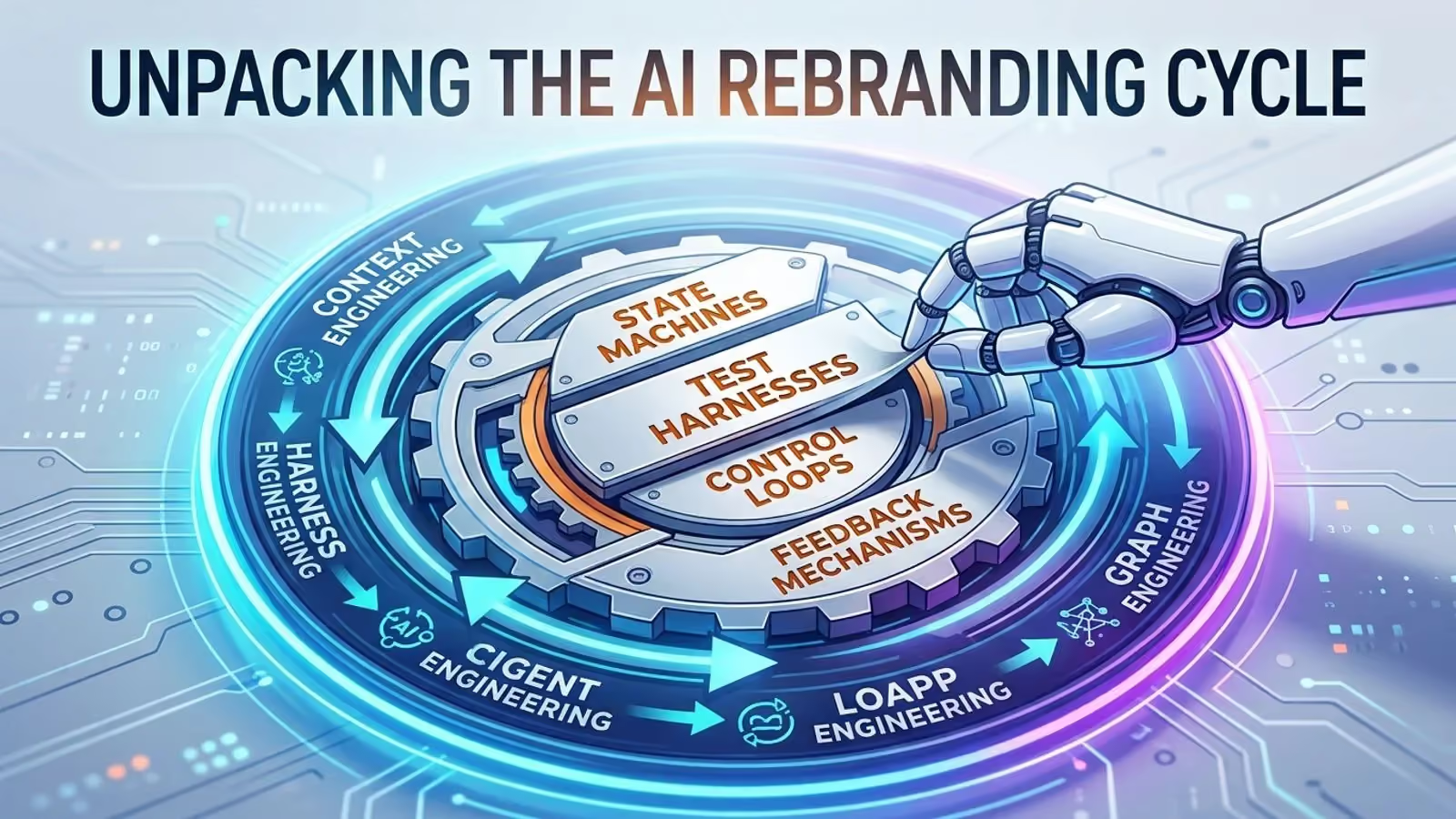
The only term I still use from the naming churn I wrote about last time is Agent = Harness + Model. The model is what you rent from someone else. The harness is the part you use every day: the loop, tool definitions, context handling, permission prompts, and the interface you type into.
Here’s my advice: stop searching for the perfect harness. Choose one, learn it well, adapt it to your workflow, and make sure it’s something you control and can’t lose access to.
There are more harnesses than there are differences between them
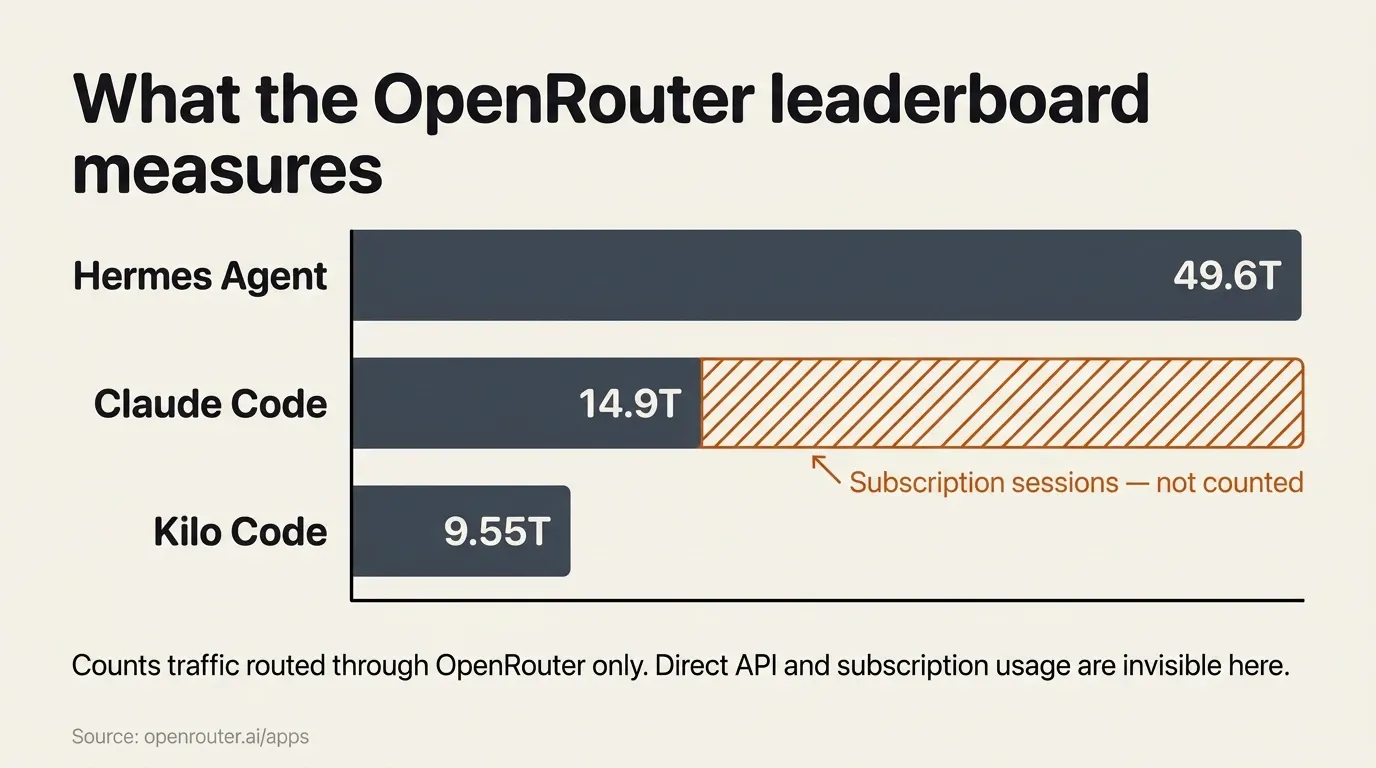
OpenRouter’s app leaderboard for the past month shows Hermes Agent at 49.6 trillion tokens, Claude Code at 14.9T, and Kilo Code at 9.55T. These numbers only include traffic through OpenRouter, not direct API usage. Sessions using Claude Code with an Anthropic subscription, as well as most Codex and Antigravity activity, aren’t counted. OpenCode publishes its own usage page with daily token and user counts. If those numbers are accurate, OpenCode should be near the top too, but since it’s measured differently, I wouldn’t compare them too closely.
The rankings change every month, but the list of features stays the same. Once you reach a certain level, every serious harness offers things like subagents, skills, hooks, custom commands, sandboxing, session branching, and some kind of plugin system. If a vendor doesn’t provide a feature, someone in the community usually does. pi keeps its core small and relies on TypeScript extensions and shareable packages for extra features. DeepSeek took it further on 13 August 2026, open-sourcing a harness under the MIT license where everything is a plugin: the model adapter, tool registry, session log, and the agent loop itself.
They still don’t behave the same
Having the same features doesn’t mean harnesses behave the same way, and the differences are bigger than they seem. Composio tested DeepSeek V4 Flash on eight harnesses using thirty real multi-step workflows and published the results on 11 August 2026. Pass rates ranged from 46.7% for OpenCode to 66.7% for pi. The cost per successful task went from 0.195. Median time per task ranged from 122.7 to 272.4 seconds. With the same model and tasks, the harness still changed every important number.
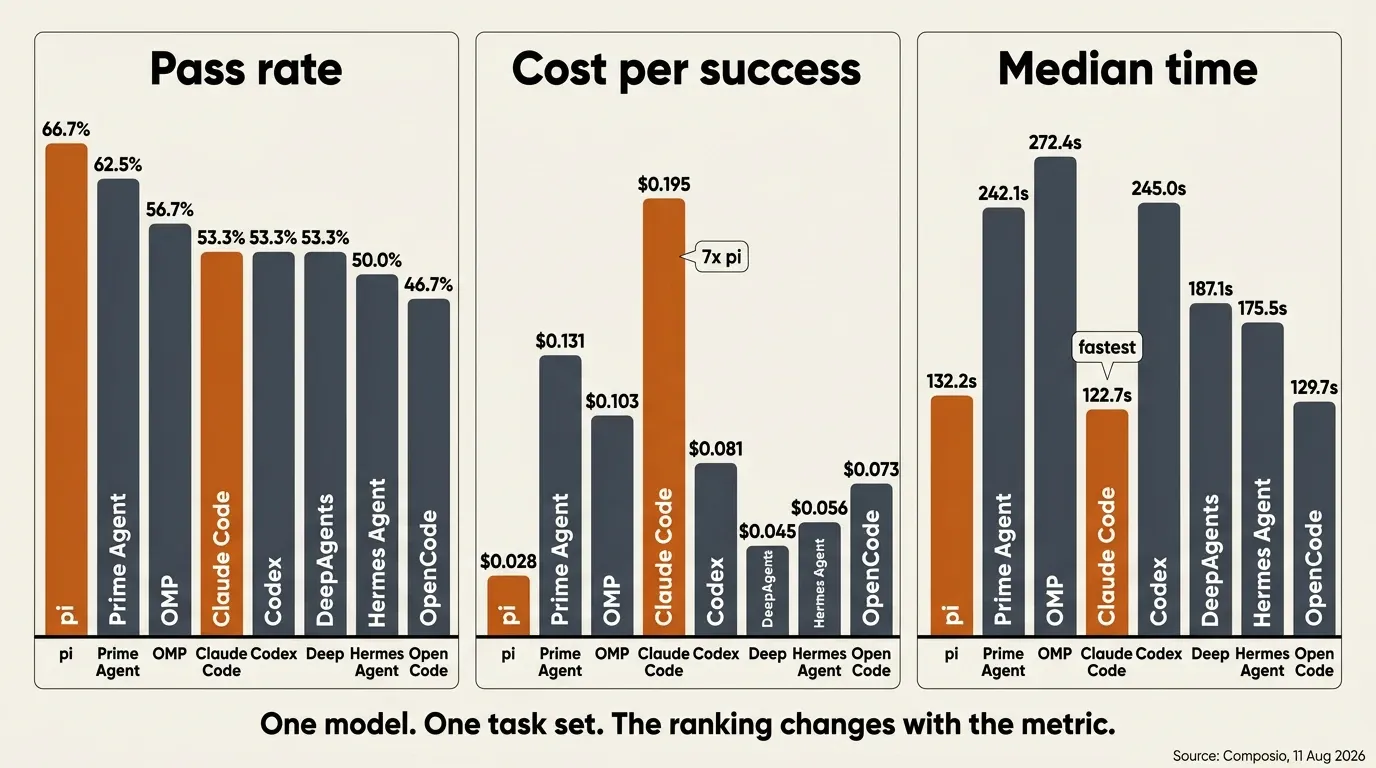
People often see results like these as a leaderboard, but that’s not really the case. Claude Code finished tasks faster than any other harness in the test, but it still cost seven times more per successful task than pi and had an average pass rate. Which harness is best depends on which numbers matter most to you. The real takeaway isn’t to switch to pi, but to realize that each harness behaves differently, and learning how yours works takes time.
Fluency is what compounds
Learning a harness inside and out takes real effort. You need to know how it handles context, what each setting does, where to put project instructions, which permissions to approve, and how to write hooks or custom commands so you can turn a task you do every week into a single word. Almost none of this knowledge carries over if you switch harnesses. Six weeks of fine-tuning just turns into a new config file and a new set of surprises.
This is the same point I made about tools and bottlenecks. A tool is only useful if you know your real constraint, and you can’t target that if you don’t understand the tool well enough.
The part that can be taken away
That’s why you should choose an open source harness to invest your time in. It’s not just because open source harnesses are easier to customize, though they are right now, but because of what happened to Gemini CLI.
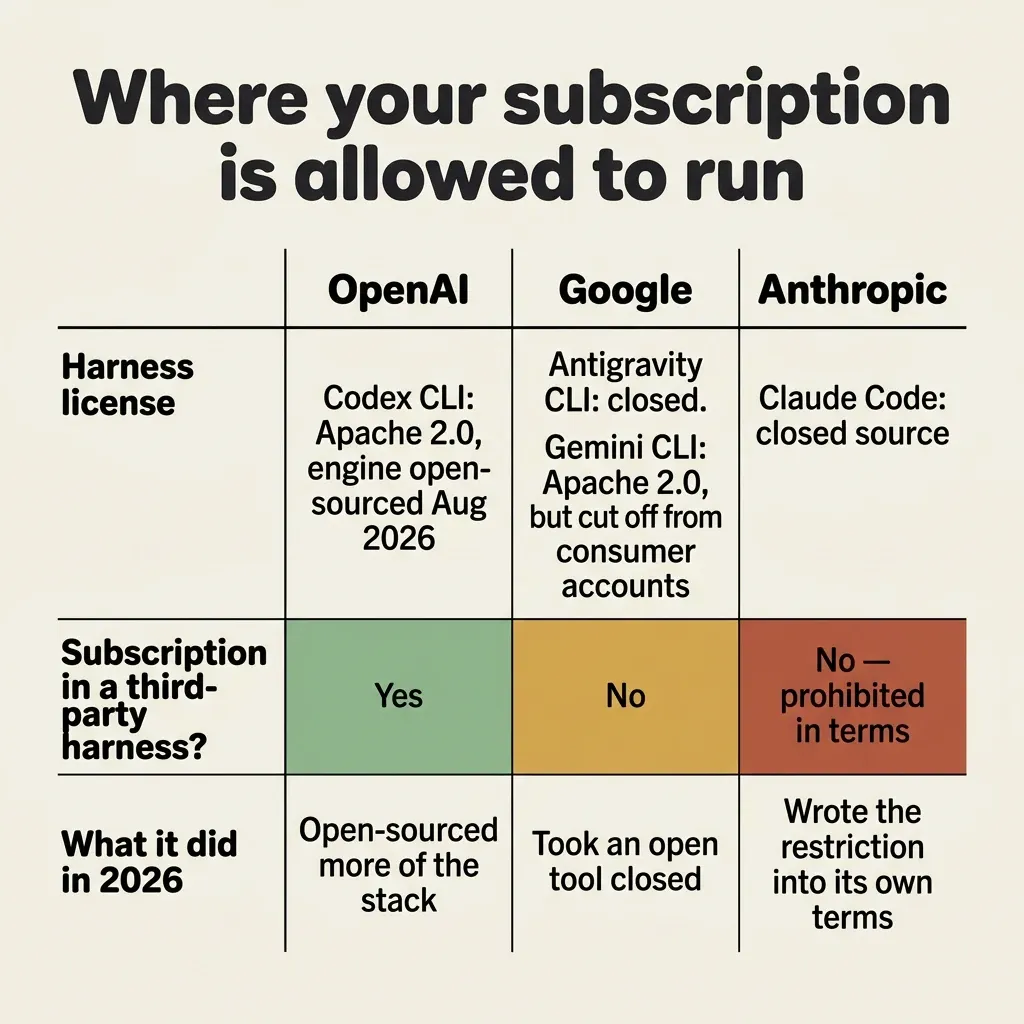
Gemini CLI was Apache 2.0, past 100,000 GitHub stars, with roughly 6,000 merged community pull requests. In May 2026 Google announced it was moving individual users to Antigravity CLI, which is closed, and on 18 June 2026 Gemini CLI stopped serving Google AI Pro, Ultra and free-tier accounts. The repository is still there, still Apache 2.0, unchanged. A license governs the code, not your access to the model behind it. Everyone who had built a working day around that tool rebuilt it anyway.
Anthropic did a stricter version of the same thing. On 9 January 2026 it began rejecting subscription OAuth tokens outside Claude Code. In February it updated its terms to say that using OAuth tokens from Claude Free, Pro or Max accounts “in any other product, tool, or service - including the Agent SDK - is not permitted”. OpenCode dropped Claude subscription support on 20 February citing legal requests, and its docs still warn that plugins restoring it exist and that “Anthropic explicitly prohibits this”. The cutoff for tools like OpenClaw landed in April.
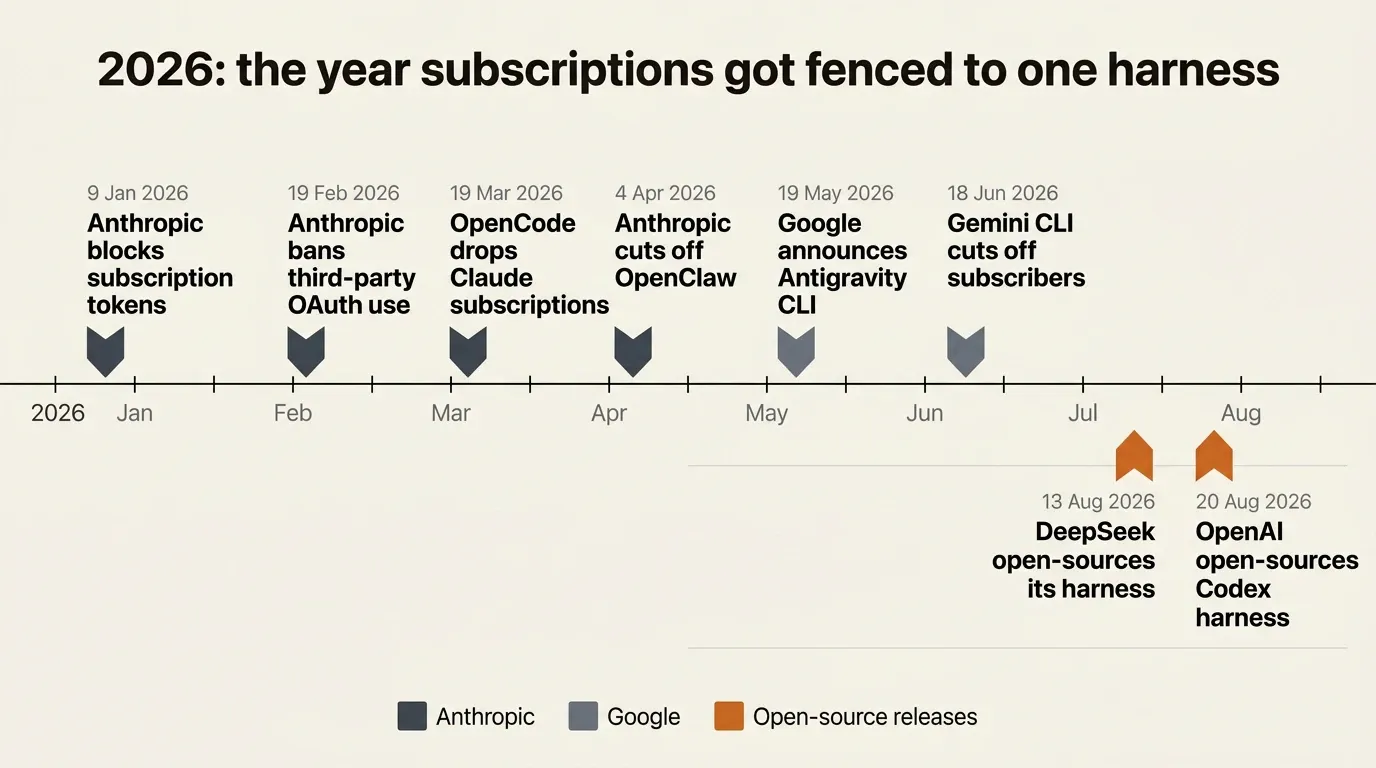
Codex is the exception, and worth being precise about. The Codex CLI is Apache 2.0, OpenAI open-sourced the harness engine behind it in August 2026, and a ChatGPT Plus or Pro login works inside third-party harnesses, OpenCode documents it as a supported provider. Of the three big labs, OpenAI is currently the least restrictive about where your subscription is allowed to run. Google took an open tool closed. Anthropic went further and wrote the restriction into its own consumer terms.
Cheap tokens are an investment, not a gift
The subscriptions are genuinely inexpensive. Pricing guides show that the 400 to $1,200 a month for API usage, and heavy users say the difference can be even bigger. These prices aren’t set out of generosity.
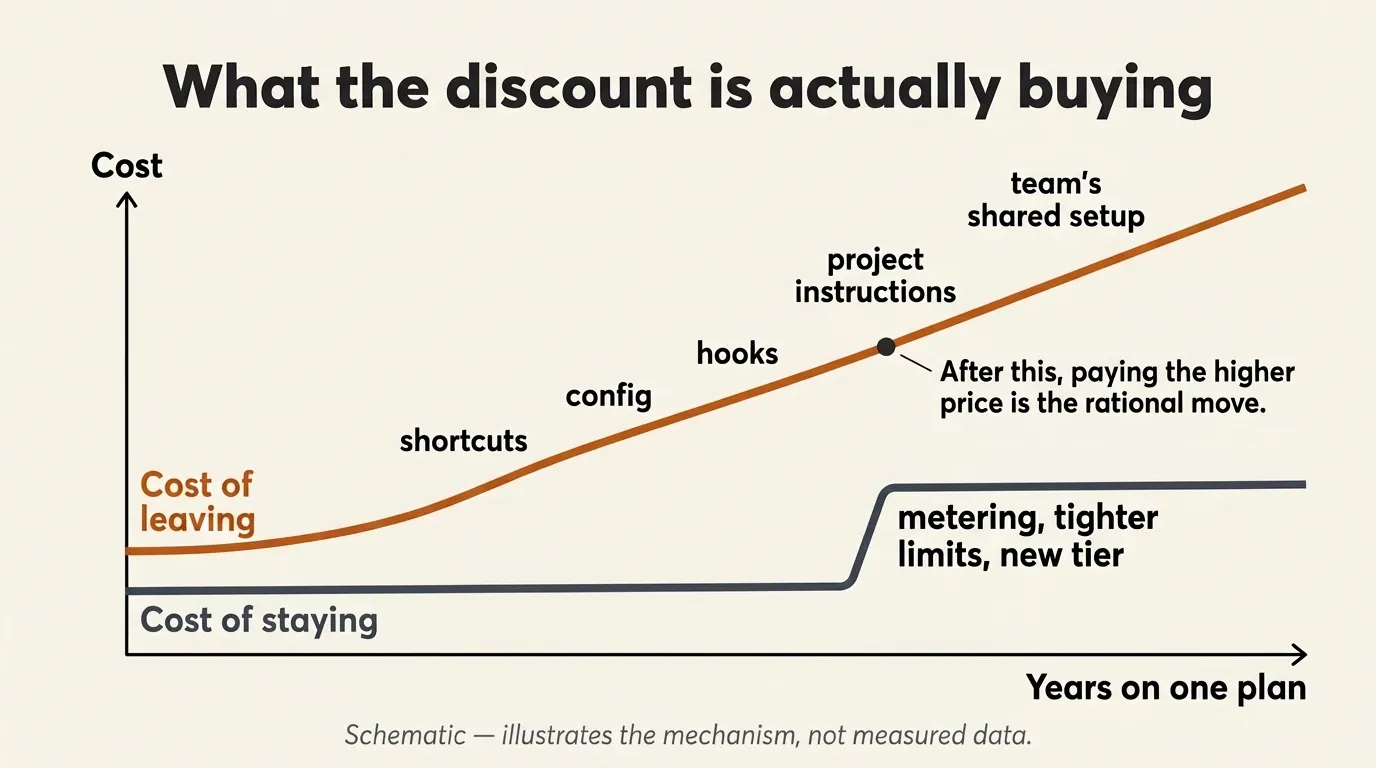
The discount is meant to attract users. After three or four years, a developer on one of these plans will have all their shortcuts, configs, hooks, project instructions, and even their team’s shared setup built around a single product. None of that transfers if they switch. When the price goes up, through metering, stricter limits, or a new higher tier, the question isn’t whether the price is fair anymore. It’s whether leaving is cheaper than staying. For someone who’s invested that much, it usually isn’t. So they pay the higher price, and it makes sense to do so.
That’s intentional. The cheap tokens aren’t just for your current usage; they’re meant to put you in a spot where, even after a price hike, staying is still your best option.
There’s a timeline for this strategy. Anthropic raised 380 billion post-money valuation on 12 February 2026. Companies at that level are expected to focus on profit, and the usual solution is metering. Cursor did something similar in 2025, quietly switching from an unlimited plan to a credit system without changing the headline price.
What this buys you, and what it doesn’t
Be clear about the limits. An open source harness won’t get you cheaper tokens. If Anthropic doubles its subscription price tomorrow, OpenCode won’t lower your costs. And the model lock-in isn’t as strong as it seems. Thanks to routers and OpenAI-compatible endpoints, switching your harness to a different model is just a config change.
The model itself isn’t what costs a lot; it’s all the knowledge you’ve acquired, and a change to the configuration is precisely the kind of thing you’d like that bill to reflect. When the harness is yours, a rise in price just comes down to deciding which model to point to this month. But if the harness belongs to the company that has increased the price, then the issue becomes one of having to relearn how you work.
Then choose one, ideally something that would still function if the company responsible for it vanished. Take the time to work on it. Read the entire config reference and write the hooks and the commands that you have always wished existed. Customize it so that another person’s pricing decision cannot undo your changes.
Consider the ecosystem of the one in which you acquire all that knowledge. Among the three major labs, Anthropic is currently the most restrictive. It was the first to take action, incorporating the rule into its consumer terms and enforcing it on time. This has nothing to do with Claude Code being a poorer harness; it isn’t. The reason is that it’s the only one you can’t take with you. Of the three, that’s the one I worry about most.