
What are microservices?
Microservices are a way of designing software where an application is made up of small, independent services. Each service focuses on a specific business need and can be developed, tested, and released on its own schedule. This approach makes development and deployment faster, simplifies maintenance, and allows teams to update their services without waiting for the whole system. It also helps teams work better together, since each team can manage its own service instead of coordinating changes in a single, large codebase.
What is the chassis pattern?
A design pattern is a reusable solution to a common problem in software projects. Instead of being a fixed way to do something, it acts as a template that can be adapted to different situations. Architectural patterns are a type of design pattern that help organize a system so it remains clear, easy to maintain, and flexible as it grows.
The Microservice Chassis pattern brings this idea to microservices. It collects the features that most services need, like service discovery, load balancing, security, and monitoring, into a shared foundation. This way, teams do not have to build these features from scratch for every service. It reduces repeated work, keeps services consistent, and lets teams focus on business logic instead of infrastructure. It also helps teams work together, since they use and improve the same shared base. In short, the Chassis pattern helps turn separate services into a well-organized, maintainable system.
In a monolith, all features are combined in one big codebase. With the Chassis pattern, these features are divided among smaller, independent services, each using the shared chassis as a base. This separation gives microservices their flexibility. Each service can be deployed, updated, or scaled on its own, without causing problems for the rest of the system.
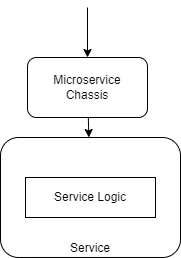
The chassis works as shared infrastructure for all microservices. It takes care of things like discovery, load balancing, and security, so each service can focus on the business logic that matters most.
Why is it needed?
The Chassis pattern is valuable in a microservices setup because it offers several clear benefits:
- Less duplicated effort. Common functionality is built once and shared, rather than reimplemented by every team that builds a service.
- More consistency. Every service uses the same foundation, so behavior is predictable across the system. This makes the system easier to understand, test, and maintain.
- Smoother development, deployment, and management. A shared foundation makes daily engineering tasks simpler and reduces the complexity teams need to handle.
- Greater flexibility and scalability. A modular setup makes it easier to scale and manage individual services, which is important for systems that handle lots of traffic and data.
- Stronger, centralized security. Features like authentication, authorization, rate limiting, encryption, and protection against attacks such as DDoS, SQL injection, and cross-site scripting can be managed in one place, instead of being built separately and possibly inconsistently for each service.
- Better collaboration. A shared foundation gives teams a common reference point, which helps people working on different parts of the system communicate better. This is important for building the system correctly and keeping it easy to maintain over time.
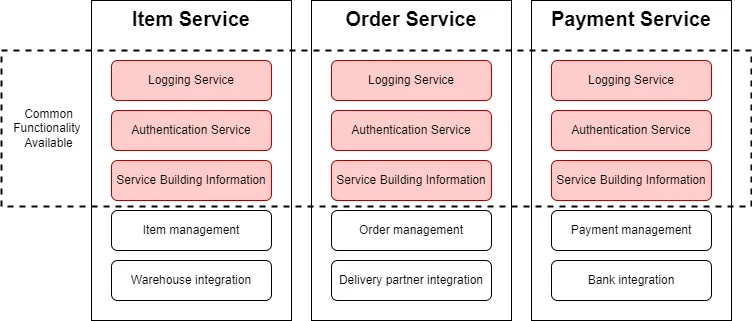
Without a chassis, creating a new service from scratch takes time, and this effort increases as more services are added. Service templates can help by giving teams a starting point, but they often lead to copy-paste code. If the build logic changes, every service that used the template must be updated one by one. The Chassis pattern handles this better by automating setup and centralizing shared features, so updates only need to happen in one place.
Practical Microservice Chassis: Functionalities & Tools
- Service Discovery: Eureka, Consul, ZooKeeper
- Load balancing: HAProxy, NGINX, Envoy
- Security: Spring Security, OAuth, JWT
- Monitoring and Logging: Prometheus, Grafana, ELK stack
- API Gateway: Kong, Tyk, Zuul
- Service Mesh: Istio, Linkerd, Consul Connect
- Configuration Management: Spring Cloud Config, Consul KV
- Distributed Tracing: Zipkin, Jaeger, OpenTracing
- Circuit Breaking: Hystrix, Resilience4j, Failsafe
- Deployment Automation: Kubernetes, Docker, Mesos
These tools are widely used, but the best choice for a team depends on its own needs and limits. This list is just a starting point, not a strict recommendation.
A complete chassis includes more features than can be covered in one article. Three main areas, service discovery, load balancing, and security, are at the heart of most chassis setups, so this article will focus on those. Other topics like monitoring, API gateways, service meshes, configuration management, distributed tracing, circuit breaking, and deployment automation also deserve detailed attention and may be covered in future articles.
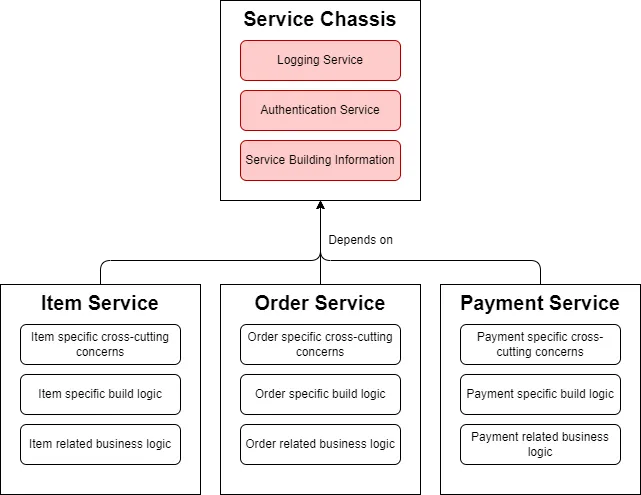
A good way to start is by creating your own chassis framework. This shared foundation should include reusable build logic, testing tools, and the frameworks or libraries needed to handle shared concerns. It should be ready for every new microservice to use.
Service discovery in a microservices environment
Service discovery is a key feature provided by a chassis. In a microservices setup, services need a reliable way to find and talk to each other. Service discovery lets services register themselves and find the other services they need.
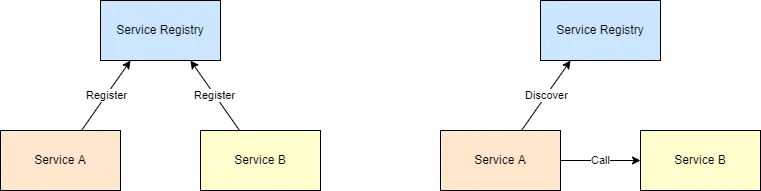
Services A and B both register with the Service Registry. This step is called service registration. When Service A needs to contact Service B, it looks up Service B’s information in the Service Registry. This is called service discovery.
Doing this well is harder than it seems, mainly because of scale. With many services in a changing environment, a custom discovery system can quickly become unreliable. The Chassis pattern solves this by giving every microservice the same, reliable discovery method, so no team has to build their own solution.
Service discovery is usually done in one of two ways, or sometimes both: using a central registry or peer-to-peer. A central registry is a special service that keeps track of all other services. Services register with it, and others ask it for information. Peer-to-peer discovery does not use a central authority. Instead, each service finds others directly, often by sharing information with each other about the environment.
Tools like Eureka, Consul, and ZooKeeper are common choices for implementing service discovery. Beyond letting services register and find one another, they typically give administrators visibility into the current state of the environment and the ability to update or remove services as needed.
Load balancing in microservices, and how the chassis pattern helps
Load balancing is another key feature of a chassis. In a microservices setup, it spreads the workload evenly across services so that no single service becomes a bottleneck. This is especially important when there are many requests or when a service uses a lot of resources.
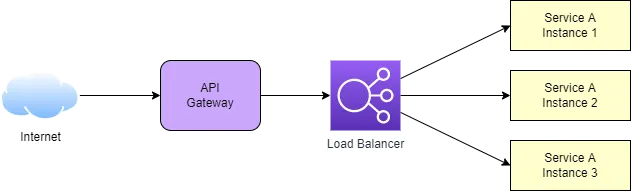
A load balancer sits in front of a service’s instances and directs incoming requests to them. This spreads traffic evenly instead of sending it all to one instance.
Like with service discovery, the Chassis pattern provides every microservice with a shared, consistent load balancing method. This consistency makes the whole system easier to understand, test, and maintain.
Tools like HAProxy, NGINX, and Envoy are common choices for implementing load balancing in a microservices environment, giving administrators visibility into the balancer’s state and control over how load is distributed across servers.
Load balancing also makes it possible to scale out by adding more instances of a microservice. This only works if traffic is spread across all instances, which is what the load balancer does. It also improves resilience. If one server fails, the balancer sends its traffic to the others, so there is no interruption.
Security considerations for microservices, and how the chassis pattern addresses them
Security is another key feature of a chassis, and it is very important. Microservices must be protected from threats like DDoS attacks, SQL injection, cross-site scripting, and other types of attacks.
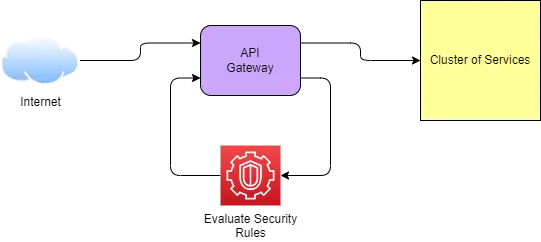
A chassis usually puts common security features in one place, so incoming requests are checked before they reach any backend service.
As with the other main features, the Chassis pattern provides a consistent security system that every microservice uses. This is better than having each service build its own, which could lead to mistakes. Consistency makes the system easier to understand, test, and maintain.
Security in this context tends to break down into a few categories: authentication and authorization, which control who can access which services; encryption and decryption, which protect sensitive data from unauthorized access; and defenses against specific attack types, which protect the system from malicious actors more broadly.
Tools like Spring Security, OAuth, and JWT are common choices for implementing security in a microservices environment, giving administrators visibility into the security posture of their services and the means to secure them.
Security works best when it is combined with the other features of the chassis. When security is integrated with load balancing and service discovery, it can make better decisions based on real-time service load and availability. This improves both the security and the reliability of the whole system.
Trends and developments in the industry
As more organizations use microservices, interest in the Microservice Chassis pattern has also grown. Several trends show how the industry is using this pattern in practice.
Service meshes are one of them. A service mesh is a dedicated infrastructure layer for microservices that handles concerns like service discovery, load balancing, and security at the network level. Tools like Istio, Linkerd, and Consul Connect have gained traction because they offer a consistent way to manage and monitor these functionalities across a system.
Cloud-native technology is another trend. Platforms like Kubernetes, Docker, and Mesos are popular because they make it easier to deploy and scale microservices. They work well with the Chassis pattern, which brings the same kind of consistency to the features running on top of this infrastructure.
There’s also a broader shift toward DevOps practices and Continuous Integration/Continuous Deployment (CI/CD) pipelines, which let teams ship microservices faster and more reliably. The Chassis pattern fits naturally into these pipelines, helping keep the system stable as deployment frequency increases.
Wrapping up
The Microservice Chassis pattern gives a solid foundation for building and deploying microservices. Instead of putting all features in one large codebase like a monolith, it spreads them across small, independent services and keeps shared concerns like discovery, load balancing, and security centralized and consistent. This setup makes microservices more scalable, resilient, and secure. As organizations move toward more modern and flexible ways of developing software, the Chassis pattern will likely stay important for building strong microservice systems.