Between hiring your first employee and landing your first real customer, most companies run into the same problem. Technical decisions start piling up faster than anyone can handle. Which cloud provider to use. Whether to redo what the first contractor built. How to respond to the enterprise buyer whose security team just sent over a questionnaire that no one knows how to answer. Founders often sense what the right answer is, but they hesitate to commit, since making a mistake here is much more costly than picking the wrong logo.

That’s usually when people start looking for a fractional CTO.
Let’s start with what the term actually means, since it gets used pretty loosely. A fractional CTO is simply a senior technology leader who works with you part-time. They’re not an employee or an agency. Instead, they’re someone who has already led engineering teams, often at several companies, and now divides their week among a few businesses that need their expertise but can’t afford a full-time salary. Sometimes it’s a day a week, sometimes two, or maybe just a regular Monday call and a Slack channel where they respond within a few hours.
The benefits are clear. You get years of hard-earned experience without having to give up equity. A fractional CTO can tell you if your team’s proposed architecture will fail at scale, or reassure you if it won’t. They’ll join engineering interviews so you don’t hire based on gut feeling. They help create roadmaps that can stand up in board meetings, push back on bad vendor contracts, and give you honest advice on whether to build or buy. Fractional CTO services exist because this kind of judgment is rare, and it’s better to rent it than go without.
Problems usually show up after a few months, and they’re rarely about the quality of advice.

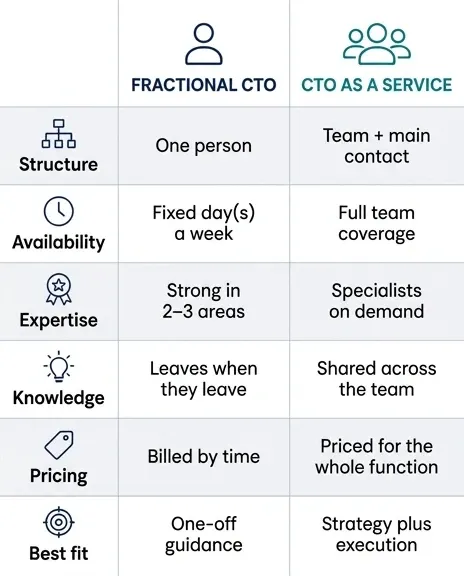
First, remember you’re hiring one person, part-time. Their schedule limits what you can do together. If your payment integration breaks on a Thursday and that’s their day with another client, you have to wait. Then there’s expertise. No one is up-to-date on cloud infrastructure, mobile, security, data pipelines, and regulatory compliance all at once. Most people are strong in two or three areas and less current in the rest, and you often find out which is which at the worst time. Plus, all the knowledge about your business stays in one person’s head. Good fractional CTOs get other offers, and if they take a full-time job, all that context leaves with them.
But the most common complaint is even simpler. A fractional CTO can tell you what to build, but someone else still has to do the building. Most of the time and money is spent turning a good architecture document into working software for real users, and a part-time advisor isn’t there to help you through that process.
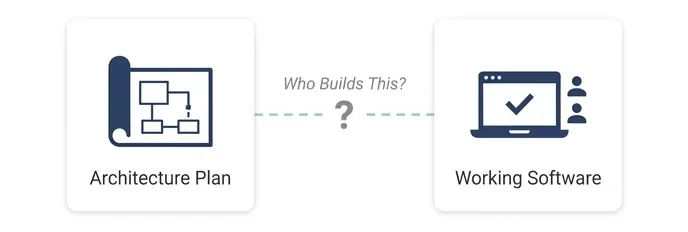
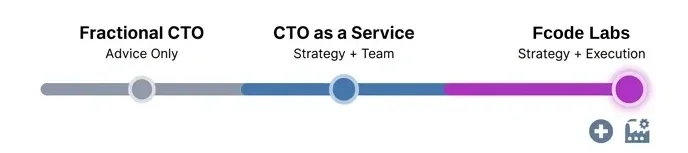
That’s the gap CTO as a Service is meant to fill. Instead of hiring one person, you work with a whole team. You still have a main contact who manages the relationship, joins your meetings, and makes decisions, but they have a team behind them. Need a security review before closing an enterprise deal? A specialist joins for two weeks. Unsure about your data model? Someone with experience steps in. Knowledge is shared across the organization, so if someone is away, the work continues. People use different names for this, like virtual CTO, outsourced CTO, service CTO, CTO as a service, consulting CTO. But they all mean the same thing: the CTO role delivered as an ongoing service, not just a single person.
How to decide which one you need
Before you start making a shortlist, figure out exactly what job you need done. This is a better filter than any list of credentials.
If you already have engineers and a team that can deliver but no one senior to guide them, a fractional CTO is often the right choice. You have the people to get things done; what you need is direction, and that’s what an experienced part-time leader can provide. The same applies if you’re filling a gap while searching for a permanent hire, or if you need CTO advice on a specific issue like a platform migration, security, or licensing.
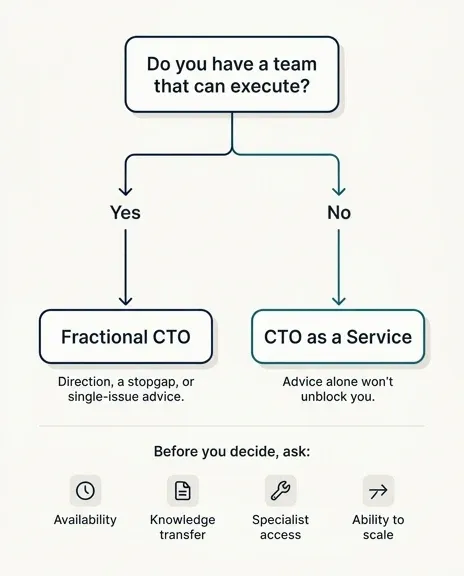
If you don’t have a team yet, the situation changes. Hiring an advisor to help with work you can’t do just moves the bottleneck. You get a solid plan, but then spend time recruiting people to carry it out, and by the time they’re ready, the plan may already be outdated.
Next, ask the practical questions, because those are the ones that matter most. What happens if this person isn’t available? Where does the knowledge go if they leave? Can they bring in a specialist for something outside their expertise, or does that mean hiring another vendor with a new contract? Can the arrangement scale up when things get busy and scale down when they don’t?
When it comes to cost, don’t compare fractional CTO services and CTO as a Service by price alone. They’re priced for different things. A fractional CTO is paid for their time, so the more days you need, the more you pay, and any specialists you need are extra. CTO as a Service is usually priced for the whole function, not just hours, so it covers a wider range and can adjust as your needs change. Either way, the invoice is the smaller expense. The real cost comes from making a technical decision that forces a rewrite after customers are already using your product.
That’s why most demand for outsourced CTO services now comes from startups and MVP-stage teams, not established companies. At this stage, what you need most isn’t just advice - it’s someone who can make decisions and then actually build the product, quickly, before you run out of time or money. When you’re pre-product, technical strategy and delivery go hand in hand: choosing your tech stack also shapes your hiring plan, timeline, and costs. If you split these tasks between an advisor and a separate development team, you end up with slow, expensive miscommunication.
Investors don’t speed things up either. No one funds a company just for an architecture document. And if you’re working in regulated or safety-critical areas like health data or factory automation, where a bug could have serious real-world consequences, it’s really important to have people with genuine experience in those fields. You want team members who know what they’re doing, rather than just someone willing to learn as they go.
How Fcode Labs fits in
That’s the part we’ve spent years perfecting.
Having had the pleasure of working with clients from various industries, we see it not just as something to be proud of, but as a wonderful advantage that enriches our experience. The same patterns show up again and again, and seeing a problem solved in one setting, like a factory, often helps us solve it in another, like a hospital. Most of our work isn’t just sitting in demo folders. It’s live, with real users relying on it every day. Much of it is software where failure has real consequences, not just a bad review. Healthcare platforms. Industrial automation. Products where getting it right is essential.
Our team is built to take your idea all the way from concept to reality. We not only tell you what should be there, but we also make it happen for you. If you need a virtual CTO to handle technical strategy, that’s what we provide, along with specialists when needed. And if, a few weeks in, you realize you need people to design, build, and launch the product, you don’t have to find another vendor or start over. We go beyond the typical CTO-as-a-Service model on purpose, because most companies eventually need both strategy and execution.
If this sounds familiar - too many technical decisions, not enough certainty, and a product that needs to launch sooner than your hiring plan allows, reach out to us at fcodelabs.com/contact-us. Bring us the messy version of your problem, not the polished one. That’s usually where the best conversations start.